
Stick to export-focussed plays, large-caps, say analysts

Get Ahead reader Anish Pillai narrates an account of how he lost a fortune by day-trading in the stock markets when the markets crashed in the third week of January.
Making the things worse, those hitting their record low share prices included big names like Reliance Power, Cipla, Ranbaxy, Ambuja Cement, Hindalco, Indian Hotels, Jaiprakash Associates, Jet Airways, Suzlon Energy and Idea Cellular. Realty majors DLF Ltd, Unitech, Parsvnath, Sobha Developers, Omaxe and Puravankara also plunged to their all-time lows.

'If you see another 1000-point correction, people may start panicking.'
A section of senior stocks brokers on Thursday demanded that the Sebi probe the reasons behind the steep decline in share prices on May 17 by analysing the trade data at the BSE and NSE and punish the guilty severely.

The Nifty had crashed to a new 21-month low of 6,825 while the Finance Minister was speaking.

Equity benchmark Sensex on Thursday plunged about 965 points to crash below the 80,000 level due to heavy selling in global equities after the US Federal Reserve signalled fewer rate cuts next year. Besides, deep losses in consumer durables, banking and IT stocks amid foreign fund outflows added to the gloom, analysts said.
All Sensex shares, except for Hindustan Unilever, ended with losses. Tata Steel fell the most by 7.33 per cent followed by Larsen & Toubro which cracked 5.78 per cent. Tata Motors, Kotak Mahindra Bank, Mahindra & Mahindra, Infosys, Axis Bank, ICICI Bank, HCL Technologies and HDFC Bank were the other big laggards. Hindustan Unilever ended marginally higher.

BSE Mid-cap index ended lower by over 2.5% and BSE Small-cap index tumbled over 3%.

As the Indian equity markets scale a new high, the gap between stock prices and the underlying corporate earnings has widened to its highest level in more than 30 years. At its current level, the benchmark BSE Sensex has run up nearly 31 per cent more than the growth in its underlying earnings per share (EPS) in the past 20 years. Most of the divergence between share prices and underlying earnings growth occurred in the past 10 years.

'As the markets are expected to remain jittery in the near term, we advise investors to use this opportunity to enter quality largecaps from a long-term perspective.'

'Retail investors, who had not seen such a massive correction in the SMID universe since COVID-19, are witnessing something like this for the first time. Panic profit booking may continue.'

Trump's tariffs, falling shrimp prices, and fears of additional US levies, spark a crisis in Andhra Pradesh's politically vital aquaculture sector.
My expectation is for the present downturn to last for between one and three months, says the investment guru.
In an hour-long chat on rediff.com on Wednesday, market expert Pranav Sanghavi offers some valuable tips.
Young investors speak about their experience in the recent market crash. They, it seems, remain undaunted and want to put more money into stocks going ahead.

The index could be vulnerable to a bigger fall given the present market dynamics.

Tata Motors is hoping to beat its target year of 2030 and have 30 per cent of its portfolio comprising electric vehicles (EVs), according to Chairman N Chandrasekaran, who was speaking at the company's last annual general meeting (AGM) ahead if its demerger.
Securities and Exchange Board of India would soon initiate action against those responsible for May 17 stock market crash
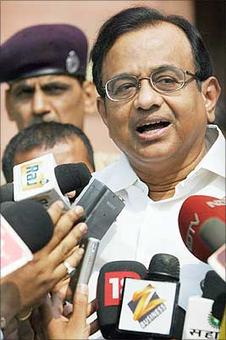
Minutes after the carnage at the bourses, government on Wednesday said it is not in favour of banning Participatory Notes and hoped that "the initial sense of alarm in stock markets" will quieten as the day progresses.

Plunged as much as 60% in some cases, amid panic selling on speculations of sale of pledged shares.

A falling rupee and lower foreign buying in equities are signals investors should watch out for, says Devangshu Datta

'The economy is clearly at a very soft spot, and earnings growth is disappointing every day.' 'After three great years, the Indian economy has hit a rough patch.'
There would be a short period of turmoil in 2015 but real returns are likely to be positive.
'India's fundamentals are a lot better (than those of other emerging market economies).' 'India will suffer (witness a fall in its stock market) what I call the second order effect.' 'And the second order will happen when these funds (belonging to macro and hedge fund investors and which have leveraged Japanese yen-carry trades), because they lose money elsewhere as lot of their positions were financed by borrowing Japanese yen, will have to book profits in investment destinations where they are making money, including in markets like India.' 'They (these investors) will have to effectively sell in countries like India and which is the consequence (the crash in equity markets) that Indian markets might see.'

This is the index's biggest single-day fall in almost a month

Eight Sensex biggies such as Reliance, L&T, BHEL, SBI and ICICI Bank are among the worst hit.
Stock markets in India have become volatile. But there is still value to be chased. Here are 7 best picks for 2007.
Sitaram Yechury, politburo member of CPM, on Friday warned the government against market volatility and FII activity.

Hyperlocal delivery platform magicpin experienced an overwhelming surge in demand at 9 am on Monday, causing its app to crash, leaving users temporarily unable to access the platform. The increased traffic came after the firm announced its "tomatoes @ Rs70" initiative last week in partnership with National Cooperative Consumers Federation of India (NCCF) and Open Network for Digital Commerce (ONDC). This led to magicpin's tomato stocks depleting within the first 10 minutes, leaving many buyers struggling to order.

Why try to time the market when time in the market works better? History shows that patient investors who stay the course often walk away with the real rewards, says Ramalingam Kalirajan.

Titan, NCC, Delta Corp, Karur Vysya Bank, Aptech, and Jubilant Life Sciences are among stocks in Jhunjhunwala's portfolio that have taken a severe hit, falling more than 50 per cent during the period.
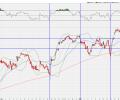
In India, however, the Nifty continues to climb a wall of worry as general elections loom, fiscal deficit surges and the current account deficit is barely under control following subdued gold and crude prices, says Sonali Ranade.
Investors on Dalal Street seem to have nothing to fear as over 228 scrips on Wednesday surged to their upper circuit levels, even as the benchmark index Sensex had plunged 10 per cent to touch its lower limit in the morning trade. As per the data available on the Bombay Stock Exchange, 228 scrips across all groups touched their upper circuit limit, representing the cap on the upward movements, while just 132 stocks touched their floor limit.

In line with a weak stock market where benchmark Sensex plunged nearly 300 points, as many as 263 stocks hit their respective one-year lows on BSE on Monday.

The Adani group stocks continued to remain under pressure on Friday, falling up to 20 per cent in morning trade, after the US-based investment research firm Hindenburg Research made damaging allegations. Shares of Adani Total Gas plummeted 19.65 per cent, Adani Transmission tumbled 19 per cent, Adani Green Energy plunged 15.50 per cent and Adani Enterprises tanked 6.19 per cent on the BSE. Also, Adani Ports and Special Economic Zone fell 5.31 per cent, Adani Wilmar dipped 5 per cent and Adani Power declined 4.99 per cent.

Inability of stocks to return to their highest levels is one of the reasons why retail investors have been reluctant to return to the market.
In the last six trading days, the Sensex, BSE's benchmark index, has declined a record 3,222.10 points - from 20,827.45 to 17,605.35. The total market capitalisation of the actively-traded stocks fell by Rs 11,85,687 crore (Rs 11.85687 trillion) to Rs 59,53,526 crore (Rs 59.53526 trillion).
The Pharma sector has underperformed the market and their performances have not been that bad for them to lag behind. I guess they are catching up with other index stocks, says market expert Pranav Sanghavi.

The interplay between domestic and foreign capital will shape India's equity markets.
 © 2026 Rediff.com - Investor Information - Advertise with us - Disclaimer - Privacy Policy - Sitemap - Feedback - About us - Terms of use - Grievances